
table of contents
Türkiye related topics
-
- From July 2023, 7, all official fees, including those for patent application procedures, will be increased by 8%.
The background to this is the rapid increase in inflation. Therefore, the actual burden on Japanese applicants is not expected to increase significantly (2020 Turkish lira = approximately 1 to 13 yen in 18, and 2023 Turkish lira = approximately 11 to 8 yen on November 1, 5.3. Turkish lira = approximately XNUMX yen).
- From July 2023, 7, all official fees, including those for patent application procedures, will be increased by 8%.
-
- From April 2018, 4, the Japan Patent Office and the Turkish Patent and Trademark Office are implementing the Patent Prosecution Highway Pilot Program
This trial program can be used to quickly obtain rights for applications such as those listed below. Please refer to the link below for detailed application requirements for the trial program.
* ① Applications in Japan that fall under any of the following
* (a) There is a Turkish application in the patent family, and in examining the Turkish application, the Turkish Patent and Trademark Office has determined that at least one of the claims is patentable.
* (b) There is a PCT application in the patent family, and during the international phase of the PCT application, the Turkish Patent and Trademark Office has expressed the opinion that at least one of the claims is patentable.
* ② Applications in Türkiye that fall under any of the following
* (a) A patent family has an application filed in Japan, and the Japan Patent Office has determined that at least one of the claims is patentable during examination of the application in Japan.
* (b) There is a PCT application in the patent family, and during the international phase of the PCT application, the Japan Patent Office has expressed the opinion that at least one of the claims is patentable.
* https://www.jpo.go.jp/system/patent/shinsa/soki/pph/japan_turkish_highway.html
- From April 2018, 4, the Japan Patent Office and the Turkish Patent and Trademark Office are implementing the Patent Prosecution Highway Pilot Program
- On January 2017, 1, the new Industrial Property Law came into effect. There are major changes to patents, industrial designs, geographical indications, and trademarks.
first
The Republic of Turkey (hereinafter referred to as Turkey) is included in the NEXT 11, which is proposed by the American investment bank Goldman Sachs as emerging countries that will achieve high growth next to the BRICs.
This paper provides an overview of intellectual property information in Turkey.
Türkiye overview
Turkey is a republic that straddles the two great states of Asia and Europe, dominating the Anatolian Peninsula (Asia Minor) in Western Asia and the Eastern Thrace region at the eastern end of the Balkan Peninsula in Eastern Europe.
Since Turkey is located at the midpoint between Europe, Asia, and the Middle East, it has flourished as a ``crossroads of Eastern and Western civilizations'' since ancient times. Turkey's land area is approximately twice that of Japan (approximately 2 square kilometers), and its population is 78 million (8,468), making it a large country representing the Middle East region. The majority of the residents are Muslims, and it is also famous as a Muslim country that has modernized through the separation of church and state. Diplomatically, it is a member of the North Atlantic Treaty Organization (NATO) and has traditionally been a member of the West.
Patent application status in Türkiye
This article provides an overview of the status of patent applications in Türkiye.
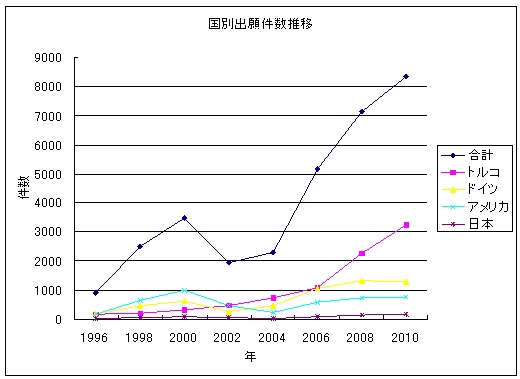
As shown in the graph below, the number of patent applications in Turkey has been rapidly increasing since 2004, exceeding 8,000 in 2010.
Although it is not shown in the graph below, the number of patent applications has continued to increase since 2011, and the number of patent applications in 2016 was 16,778, of which patents from Japan to Turkey The number of applications has also increased to 489 (more than 2.5 times compared to 2010).
As described above, the number of applications in Turkey is increasing year by year, and since Turkey has the potential as a production base for Europe and other countries, it is expected that the number of applications will continue to increase in the future.
[Reference] Trends in the number of applications by country in Turkey (graph)
Acquisition of rights in Türkiye
Application route
Next, we will outline how to obtain rights for inventions in Turkey.
Turkey is party to the Paris Convention, EPC, and PCT.
Therefore, in order for foreigners to obtain rights in Turkey,
- ①Paris route
- ②PCT route
- ③EPC route
An application will be filed with the Turkish Patent Office (hereinafter referred to as TPI) through either of the following routes:
Flow of obtaining rights
When a patent application is filed, a formalities examination is first conducted. If any deficiencies are discovered during the formalities examination, the reasons for refusal will be notified and you will be given an opportunity to submit written opinions and amendments.
The application documents, as in Japan, include the application, specification, claims, abstract, and necessary drawings. Although the application language is Turkish, it is also possible to submit application documents in English, French or German, in which case a Turkish translation must be submitted together with an additional fee within one month from the filing date. There is a need.
After formality examination is completed and 18 months have passed since the filing date (or 18 months from the priority date if priority is claimed), the application will be published and the contents of the application will be published in the official gazette.
It should be noted here that in the case of a Turkish application, a request for a prior art search must be made within 1 months from the filing date (or XNUMX months from the priority date if priority is claimed). If a prior art search is not requested, the application will be deemed to have been withdrawn.
After filing a request for a prior art search, the applicant will be notified of the prior art search report, and the applicant must file a request for substantive examination within three months of this notification.
After a request for substantive examination is filed, substantive examination begins. If it is determined in the substantive examination that the patentability requirements are not met, the applicant will be notified to that effect and given an opportunity to submit written opinions and amendments.
Similar to Japan, the patent requirements are novelty, inventive step, and industrial applicability. In addition, as in Japan, inventions that may violate public order and morals, such as discoveries, scientific theories, plans, and methods and rules regarding mental actions and activities, are not subject to patents. It should be noted that computer programs that are patentable in Japan are not patentable in Turkey.
If it is determined in the substantive examination that the patent requirements are met, the patent will be granted registration, a patent right will be granted upon payment of the registration fee, and the registered contents will be made public. The term of validity expires 20 years after the filing date.
About implementation obligation
The Turkish Industrial Property Law stipulates the obligation to exploit patented inventions, and stipulates that a compulsory license may be requested for patented inventions that are not implemented. It is considered preferable to keep these provisions in mind after obtaining rights.
Specifically, it stipulates that interested parties may request a compulsory license in the following cases:
●Non-implementation from the date of application or the date of publication of registration
・From the expiration date of 3 years after the decision to grant a patent was published in the official gazette or 4 years after the date of the patent application, whichever is later, ① the exploitation of the invention has not been started, or ② there is no serious effort to carry out the exploitation. No practical efforts have been made, or (XNUMX) the implementation of the patent is not at a level that satisfies the needs of the domestic market on the date of the request for the granting of a license.
●Suspension of implementation
・If the implementation of the invention has been interrupted for more than three consecutive years without justifiable reason.
Other application forms in Türkiye
In Turkey, in addition to the above-mentioned regular patents, there are application forms called "additional patents" and "secret patents." Applications for “utility certificates” are also accepted.
Below, these application aspects will be outlined.
Additional patent
The invention that is the subject of a patent of addition is an invention that improves and develops the invention of the main patent, and the requirements for a patent of addition are that it shares the main inventive concept of a comprehensive nature with the main patent and improves and develops the invention of the main patent. It is to be. In other words, the requirements of novelty and inventive step are not required for patents of addition.
The period for filing an application for an additional patent is until the decision on the main patent is issued. However, if the main patent is rejected, an additional patent will not be granted.
An application for a patent of addition can be converted into an application for a main patent while the application is in the process of being filed.
secret patent
A secret patent is an application for an invention that is determined to be important from the perspective of national security, and is registered as a classified patent application for which the Ministry of Defense has decided to process the application in secret. It is something. The classification will be canceled at the request of the Ministry of Defense, and the secret patent will be processed as a patent application from the date of cancellation of the classification.
Practical proof
The subject of protection of a utility certificate is an "invention" like a patent, but inventions of processes, manufacturing methods, or inventions related to chemical substances are not protected by a utility certificate. The duration of the utility certificate is 10 years from the date of application.
The requirements for registering a utility certificate are "inventions that are new and have industrial applicability." Similar to Japanese utility models, at the examination stage, only whether the formal requirements are met and whether the subject matter of the application matches the object of protection are examined.
A utility certificate application can be converted into a patent application during the period until the decision to register is made, and it is also possible to change a patent application to a utility certificate application.
Türkiye New Industrial Property Law comes into force
In Turkey, the new Industrial Property Law came into effect on January 2017, 1, incorporating provisions regarding the protection of patents, industrial designs, trademarks and geographical indications into one law. The new Industrial Property Law will come into effect from January 10, 2017, but the old law will also apply to applications filed before January 1, 10. The following items are the main revisions.
Changes in design/trademark renewal application period (updated: March 2018, 3)
The new Industrial Property Law came into effect in Turkey on January 2017, 10, and among the amendments, the amendments to the renewal period for designs and trademarks became effective from January 2018 of this year (1).
改正前は、更新登録申請及び更新登録料納付は月末まで認められていたが、2018年1月10日以後は、実際の満了日までとなる。例えば、2008年1月18日に出願された商標の更新申請期間は、2018年1月31日までではなく、2018年1月18日までとなる。
By the way, the term of trademark is 10 years from the filing date, and it can be renewed any number of times. On the other hand, the term of a design is five years from the filing date and can be renewed for up to 5 years.
Applications for renewal registration can be made from six months before the expiration of the term, and there is a grace period of six months after the expiration of the term.
design
① Timing of examination for novelty
Previously, the examination for novelty was carried out on applications that met the formal requirements after the formality examination, but after the revision, it is now carried out at the formality examination stage.
② Shortening the period for filing an opposition after registration
Third parties had six months from the date of public notice to file an opposition, but after the revision, this has been shortened from the previous six months to three months.
③ Protection as an unregistered design
Designs made available to the public for the first time in Turkey are now protected as unregistered designs. It is also possible to exercise the right against a third party who implements a design that is the same as or similar to the unregistered design. The period of protection is three years from the date of first availability to the public.
④ Characteristics description
The characteristic description is now an optional document rather than a required document.
商標
① Introduction of written consent system
Previously, co-registration of identical or similar trademarks was not allowed, but due to the revised law, the reason for refusal can be overcome by submitting a letter of consent from the trademark owner cited at the time of examination. Now you can. Please note that the consent form can be submitted even before the reasons for refusal are issued.
② Change of opposition period
Interested parties had three months from the date of publication of the application to file an opposition, but the amendment has shortened this from three months to two months. Furthermore, the period for petitioning for significance for trademark applications filed before January 3, 3 remains 2 months.
③ Request for proof of use in response to opposition
Previously, if the registered trademark that was the basis of the opposition was registered more than five years ago, the applicant could not request proof of use from the opponent, but with the amendment, , you can now request proof of use. If proof of use cannot be provided, the opposition will be dismissed.
④ Where to file a request for cancellation of non-use
Previously, requests for cancellation of non-use had to be filed in court, but the revised law will allow them to be filed with the Patent and Trademark Office. The Patent and Trademark Office has been given a grace period of up to seven years to prepare, and until then, the court will continue to have jurisdiction.
⑤ Color trademarks, sound trademarks, motion trademarks
The requirement for color, sound, and motion trademarks to be reproduced on paper has been removed.
⑥ Renewal period
Previously, the term expired at the end of the month, but under the revised law, the term expires on the actual expiration date. You can apply for renewal registration 6 months in advance, and there is a grace period of 6 months after the expiration of the validity period. Please note that this provision will become effective from January 2018, 1.
Patent
① Mandatory request for substantive examination
It has become compulsory to file a request for substantive examination. Previously, it was possible to choose between a patent granting system with substantive examination and a patent granting system with a duration of 7 years without substantive examination, but as a request for substantive examination has become mandatory, the duration of XNUMX years has been changed. The patent granting system in XNUMX is no longer available. If the patent granting system with a request for substantive examination is not selected, the application will be considered withdrawn.
② New establishment of opposition system after patent right is granted
It is now possible for a third party to file an opposition after the patent right is granted. The filing period is within six months from the publication of the patent gazette.
Turkey also allows third parties to provide information. Information can be provided from the publication date of the application.
③ Deletion of criminal provisions
There are no longer criminal provisions regarding intellectual property rights other than trademarks. Therefore, infringements of patent rights, etc. will be dealt with solely based on civil provisions.
About trademark application in Türkiye
The number of trademark applications in Turkey was 19,790 in 1998, which doubled to 74,991 in 2008. It can be seen that the need for protection through trademark rights is increasing with economic growth. The number of trademark applications in 2009 was 71,604, which is a decrease compared to 2008.
Of the number of trademark applications filed in 2009, 59,838 were filed by Turkish residents, in contrast to patent applications in that the majority of applications were filed by Turkish residents. The number of trademark applications filed from Japan to Turkey is 365.
Turkey is a member of the Paris Convention and the Madrid Protocol, and the basic laws and regulations regarding trademarks are almost the same as those of developed countries. It is possible to file an application claiming priority based on the Paris Convention, and it is also possible to select Turkey as a designated country and apply based on the application and registration in the Madrid Protocol member countries.
A trademark application will be published after undergoing formal examination and substantive examination. The opposition period is within three months after the publication of the application, and interested parties can file an opposition during this period (before grant). If you are not an interested party, you can submit a written opinion asserting that the applied trademark falls under the grounds for non-registration by submitting observations (before grant). The difference from filing an opposition is whether or not you can become a party to the proceedings at the TPI.
As a result of the examination, if it is found that there are no defects, if the defects are corrected, if no opposition is filed within a specified period, or if the opposition to trademark registration is ultimately rejected, the decision to register the trademark will be made. . The term of trademark rights in Turkey is 10 years from the date of filing and can be renewed every 10 years.
Amendments to the Enforcement Regulations of Industrial Property Law in Türkiye
On July 2019, 7, a part of Turkey's Industrial Property Law Enforcement Regulations was revised, and the submission of a "notarized signature" that was required when applying for partial renewal of a registered trademark was no longer required, and the procedure was Simplified.
Under the pre-amendment rules, for applications for partial renewal of registered trademarks, natural persons were required to submit a notarized signature or a notarized copy thereof. Additionally, corporations were required to submit a notarized signature list or a notarized copy thereof.
However, obtaining notarization is costly and time consuming, increasing the burden on applicants to prepare documents. Therefore, with this amendment, notarized signatures or a notarized signature list are no longer required for the procedures listed below.
If the application is filed through a lawyer or agent, a power of attorney must be submitted to the Turkish Patent and Trademark Office together with the application, clearly giving the lawyer or agent the authority to carry out the application.
- Updates regarding some products and services within the scope of registered trademarks
- Withdrawal of part or all of a trademark application before registration
- Disclaimer of a registered trademark for all or part of the goods or services within the scope of the registered trademark
- Withdrawal of an opposition filed against a published trademark application
- Withdrawal of appeal against decision regarding trademark application
- Disclaimer of liability for the control of rights or uses derived from the registration by the GI holder
*Notes when specifying Turkey on Madpro*
The opposition period is three months from the date of publication of the international registration in the Trademark Bulletin of the Turkish Patent Office.
However, [if Turkey is designated in Madpro], if an opposition is filed during this period, the Office will not notify the applicant and WIPO, but will only be notified after the first decision on the opposition..
- ① Since the applicant is not notified of an opposition to an international registration, there is no clear deadline for responding to an opposition to an international registration. However, it is possible to respond (submit a written opinion) within two to three months from the date of the opposition (however, submission of a written opinion is not mandatory).
- ② If a written opinion is submitted, the first decision will be made after referring to the written opinion. If no written opinion is submitted, the first decision will be made by referring only to the opponent's written opposition.
- ③If you are dissatisfied with the first decision, you may request a retrial by a higher authority (Trial Board/Intellectual Property Court). However, if the case goes to court, it will cost a lot of money and take one to two years.
Therefore, it is advisable to ask a local representative in Turkey to monitor the presence or absence of any objections, and to counter-argue and deal with the objections before the first decision is made.
◆In light of the above circumstances, we are able to monitor whether or not there are any objections to international registrations that designate Turkey (separate fees apply). If you wish to watch, please contact our office.
About design applications in Türkiye
Design protection provisions
Turkey's design system is regulated by the Industrial Property Law and the Industrial Property Law Enforcement Regulations. The competent authority is the Turkish Patent and Trademark Office.
What is protected by a design?
1 Definition of design
"means all the various patterns such as lines, colors, weaves, shapes, sounds, elasticity, material and other features that can be perceived by the five senses as constituting the appearance of the whole or part of an article or its decoration" ” is defined.
2 Target of protection
"Article" is defined as "an industrial or handicraft article, a component of a complex system, an assembly, a constituent article, a packaging, an exterior, a graphical representation, and a typeface."
(1) What is subject to protection?
Designs include industrial designs, graphic designs, fashion designs, architectural designs, etc.
・Packaging containers, images (no need to specify the product), dynamic designs.
- Real estate, buildings, three-dimensional images, holograms, lights (fireworks, illuminations, etc.), graphic symbols, textiles (no need to specify items), indoor layouts and displays of stores, etc., icons, blueprints, etc. that are not subject to protection in Japan. will also be protected.
(2) Items not subject to protection
・Computer programs, semiconductor products, and items that cannot be seen with the naked eye
(3) Protection of unregistered designs
It was introduced with the enactment of the Industrial Property Law on January 2017, 1. Designs made available to the public for the first time in Turkey are now protected as unregistered designs if they are novel and unique. It is also possible to exercise the right against a third party who works a design that is identical or very similar to the unregistered design. The period of protection is three years from the date of first availability to the public.
Design protection requirements
In order to receive protection under Turkish Design Law, the following three requirements must be met.
①Novelty
A design is considered novel if, before the filing date or priority date, the same design is not available to the public throughout the world (including by sale, use, publication, advertising, exhibition, or any other form of similar action). It can be done. Designs that differ only in minor details are considered to be the same design (Article 6 of the Design Act).
②Uniqueness
The overall impression that the design gives to the implementing party is significant compared to the overall impression given to the implementing party by a design that has been published in the world before the filing date or a registered design that has been published by the Office and has not expired. If there are differences, the design is considered to be unique (Article 7 of the Design Act).
③ Designs that violate public order and morals and general moral laws cannot be protected (Article 9 of the Design Law).
Design application procedure
(1) Creator of the design
The creator of a design is the person who created the subject matter of a design application.
If there is more than one creator, each creator must be listed on the application.
If the creator's name is not listed in the application, the creator may request that his or her name be listed as the creator.
The creator may request that their name be kept secret.
(2) Documents and information required when applying for a design
- Application form containing information about the applicant's identity
・Drawings/photos showing the external appearance of the design that can be reproduced
- Name of the article in which the design is incorporated or used
・ Name of the creator or name of the group that created the design
・How the right to apply for a design was acquired from the creator
・If you wish to request publication postponement, please request publication postponement.
- Information about the agent (if one has been appointed)
Public notice of design
Publication can be postponed for up to 3 months from the filing date (priority date). Note that under Japan's secret design system, a design can be kept secret for up to three years from the date of registration, whereas in Turkey the period for which a design can be kept secret is slightly shorter. would be necessary.
Design opposition
Third parties will have three months from the date of publication to file an objection.
- 1. Does not meet the definition of a design
- 2.No novelty or originality
- 3. Conflict with earlier Turkish design application
- 4.Violation of public order and morals
Duration of design
The duration of a design right is five years from the filing date, but it can be renewed up to four times. Therefore, design rights can last for up to 25 years.
Start of use of the DAS system as a provider agency
The Turkish Patent and Trademark Office announced that it has joined the Digital Access Service (DAS) provided by the World Intellectual Property Organization (WIPO). The use of the DAS system has started in Turkey from June 2022, 6. This has made it possible to electronically exchange priority documents between the Japanese Patent Office and the Turkish Patent and Trademark Office.
At present, the Turkish Patent and Trademark Office participates in the DAS system only as an office that provides priority documents to a second country (Depositing Office), and as an office that acquires priority documents from a first country (Acquiring Office). It does not provide services as an Accessing Office.
Amendments to the Enforcement Regulations of Industrial Property Law in Türkiye
On July 2019, 7, a portion of Turkey's Industrial Property Law Enforcement Regulations was amended, making it unnecessary to submit a "notarized signature" that was required when applying for partial renewal of a registered design. Procedures have been simplified.
Under the pre-amendment regulations, natural persons were required to submit a notarized signature or a notarized copy of the signature for the above application. Additionally, corporations were required to submit a notarized signature list or a notarized copy thereof.
However, obtaining notarization is costly and time consuming, increasing the burden on applicants to prepare documents. Therefore, with this amendment, notarized signatures or a notarized signature list are no longer required for the procedures listed below.
If the application is filed through a lawyer or agent, a power of attorney must be submitted to the Turkish Patent and Trademark Office together with the application, clearly giving the lawyer or agent the authority to carry out the application.
- Partial renewal of registered design
- Partial or complete abandonment of registered designs
- Withdrawal of an opposition filed against a published design application
- Withdrawal of appeal against decision regarding design application
■The Hague Agreement
- 1) Parties to the Hague Agreement: Geneva Act (1999)
- 2) Effective date: July 2005, 1
- 3) Declarations made by Parties
・The period of refusal shall be 12 months. (Rule 18(1)(b))
・Effective date of international registration (Rule 18(1)(c)(i))
- Maximum duration of protection under national law (Article 17(3)(c))
Links to Türkiye-related information
Turkish Patent Office:
http://www.turkpatent.gov.tr/
Overview of systems and legal treaties of foreign countries, regions, and institutions (Japan Patent Office): Japanese translation of Turkish Industrial Property Law can be viewed:
https://www.jpo.go.jp/system/laws/gaikoku/mokuji.html
[Column: Relations between Japan and Turkey - Türkiye, a pro-Japanese country]
Historically, Japan and Turkey have had a friendly relationship, and it is said that many Turkish people have a favorable impression of Japanese people.
The origin of this friendly relationship was the official visit to the Ottoman Empire by Their Royal Highnesses Prince and Princess Akihito Komatsu in 1887, and the Ertugrul Incident in 1890.
In the Ertugrul incident, the warship Ertugrul, carrying Admiral Osman and others dispatched to Japan in return for the official visit, sank in a typhoon off the coast of Kushimoto, Kishu on its way back, killing 587 crew members. In this incident, 69 people were rescued through the generous efforts of the Japanese public and private sector, and were later repatriated to Turkey by a Japanese cruiser.
This generous follow-up response by the public and private sectors is said to have touched the hearts of Turkish people.
Japan and Turkey have a historically friendly relationship. Against the backdrop of Turkey's economic development, the two countries may be able to strengthen each other's presence as economic partners in the next few years.
Chief Patent Attorney/Specific Infringement Litigation Agent Specialist Nobukazu Shiokawa